Showing posts with label physics. Show all posts

Thursday, May 14

Back to the Future

One point twenty one gigaWatts!

Time travel. Okay, so here's the deal. There's really nothing in the laws of physics which explicity prevent it under any circumstance. In fact, there's an abundance of loopholes and nifty tricks you can theoretically perform using current theories and exotic measures.

First, the future.

This is easy. Einstein's Theory of Special Relativity tells us (and this is totally 100% true) that the faster things move, the heavier they get, the thinner they get, and they experience less time than someone standing still. This effect is only really noticable when you get near to light speed.

So, you could zoom around in a spaceship at say 90% of the speed of light, return to Earth one year later - but you'd find it was actually two years later on Earth! The faster you go, the further you travel forward in time relative to everyone else.

Of course, going that fast takes a huge amount of energy, and the faster you go, the harder it gets to go faster. You can't reach light speed. So it'd generally be better to not have to go so fast in order to travel forwards. Thanks to Einstein's Theory of General Relativity - we don't have to. Instead, we bend space-time around ourselves to get a similar effect.

This is what's known as a gravity well. All matter bends space-time around it, and the more of it you get in one place (density), the steeper the sides of the well. If you could compact, say, a large planet like Jupiter down to... about the size of the Atomium in Brussels, then get inside - you'd get a very similar effect.


A lot of time travel tricks revolve around bending this space-time membrane in such a way that our normal everyday view of the world becomes warped, and things that seem completely impossible are in fact the only mathematically valid solution. We've demonstrated the future, is easy enough, but what about the past?

Coming Soon: Back To The Future II - wormholes, cosmic strings and other cheap tricks

CovertHolistic

Sunday, May 10

The Most Beautiful Equations

Sometimes mathematics is beautiful. It's a hard thing to observe; you need to peer through various mystifying levels of symmetries and distractions, until you finally arrive at that most elusive moment where you suddenly realise it's all really simple.

Many of the greatest equations, theories and postulates have relied on the power of their beauty. Einstein's E=mc2 has entered the public consciousness like no other, while many others intrigued and delighted the scientific community without much publicity.

Gauss
Gauss's integral for example, reduces this technically baffling integral to a silly and simple number - albeit one which goes on forever.. 1.772453850905516027298167483314...

Comprehending the lateral method used to solve this problem was a major moment in my scientific education. The solution appears to be infinitely unsolvable, if you think of 'x' being a straight line, which as far as any really grasped, was mostly what integration seemed to be about.

However, if you instead think of this problem in two equal dimensions, you can bend the co-ordinates into a circle. Suddenly, as the circle closes, the difficult bit drops off and you can solve the bugger easily to get 1.77...

This identity is used heavily in quantum mechanics, in fact - the whole field is underpinned by the kind of logic used in this solution.

Euler

Euler also used circles to describe other strange and useful numbers. Imagine a second hand travelling round the clock face. Imagine a straight line drawn from 9 to 3. The question is, how far away from that line is the tip of the second hand, as it travels round? If you plot a graph of that distance against time, you'll get a sine wave:


If you instead imagine a straight line between 12 and 6, and plot that, you'll get the same thing, except the start point will be a quarter of a circle further round. These two waves, one '3 hours' out of phase with the other, are called sin and cos.

We would usually use an angle called a radian instead of the clock metaphor. A clock has 12 hours, a circle has radians - twice the number π. So the two waves are π/2 ( 2π / 4 ) out of phase, and the two waves are sinθ and cosθ where θ revolves all the way around from 0 to 2π, like the hand making a full revolution.

Euler showed us that you can treat sin and cos as really the same things, if you use something called an imaginary number.

Okay, I'm thinking of a number. What is it? "Well.. " you say, "it could be anywhere between zero and infinity!" What about negative numbers? "Well, minus infinity to infinity then!".

And you'd have me there. But suppose instead I was thinking of the square of a number, there'd be no point guessing a negative number because any number, positive or negative, gives you a positive number when you square it. In fact, if someone claims they've thought of one, well, it can't be real can it? No real numbers do that! Must be some kind of.. imaginary number, hah!

In mathematics, existing and being real thankfully don't have to mean the same thing, so we can imagine numbers which exist but aren't real. They'll actually really useful, and in fact have a lot to do with circles, and waves, and lots of really geeky physics stuff.


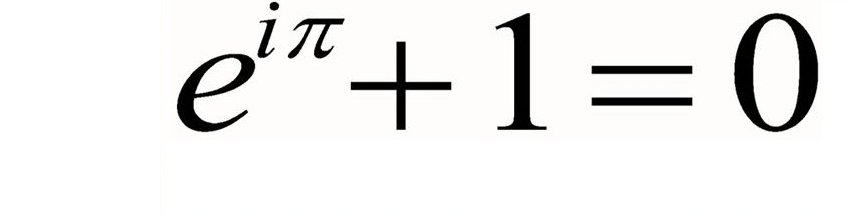
Don't worry if that's a bit confusing, The point is, when you combine in the radian idea, the sin and cos, the imaginary number idea, and the exponential (I won't go into that here - check the link at betterexplained.com) you arrive at the most startlingly simple statement:

This, I believe, is the most beautiful equation. The soaring exponential, the elusive imaginary, the reliable circle, the triumphant '1', then equality to nothing. It's the poetry of the universe, and it's just the first line.

Thursday, April 9

Mathematics, the Universe and Everything

A few weeks ago on Horizon, comedian Alan Davies went on a journey through time and space...

Boosh. No, actually - maths.

Marcus de Sautoy is an Oxford professor of mathematics; I've read through his book The Music of the Primes several times and it's an inspiring read - flowing with the genius of a man who's not only able to see the numbers clearly, but who can vividly communicate the beauty of maths - it's immortality, it's infallibility, it's truth.

Marcus was tasked with showing Alan this wonder, and convincing him that maths can actually be amazingly good fun! There's a common stereotype and cultural stigma associated with mathematics and the sciences, which you'll be familiar enough with that I shan't go into it.

The problem is, that to understand/contribute to most of the fun stuff, you need to learn a lot of the really quite difficult stuff; this can require a certain mindset and it's not always obvious what the pay off is going to be for putting in the effort.

The quick wins are the situations where you can demonstrate a fundamental and beautiful idea without using any of what most people would consider "maths". Marcus introduces Alan to a fourth dimension in space, using physical examples and discussion in the place of equations and laws. They then explore the shape of the universe, and describe some of the implications of Perelman's proof of the Poincaré Conjecture.

[That's to do with how the entire universe can be finite, but still not have any "edges" - there's no magical "end of the universe", much to Douglas Adam's and Metron's disappointment...]

The show is a wonderful insight into the true importance of mathematics, and seeing Marcus's energy and Alan's glee on grasping new concepts makes me proud to be a student of the sciences. More importantly, we end on the revelation that:

The universe seems like it might be the icing on a four dimensional doughnut. Believe.

Anyway, with luck it might still be on the iplayer - check it out!

Thursday, March 5

Blinded by Greed and Religious Delusions

If there's a grand global warming conspiracy, this is it.

Watch some amusing but slightly terrifying videos

Also check out Ignorance Corner, and bask in the power of greed and stupidity.

Tuesday, March 3

The Spirograph of Everything

I've added this pic of an E8 Lie Group. Isn't is neat?

This is a mathematical symmetry - and the highest order (read: "most beautifully complex and simple at the same time") of it's type that can be constructed. I think it's really pretty, and what's more, it's a usable gauge group (read: "something that behaves nicely enough to use in hardcore physics") into which the Standard Model of Matter fits nicely. There's plenty of gaps left to fill - so do any of them really exist as symmetries of particles in our universe?

Bring the LHC, let's find out!

Garret Lisi discusses the implementations of this symmetry in his "theory of everything" on TED.com - check it out. The rotating visuals go a long way to showing you how it works.


ps. yeah, so the LHC needs a bit of tweaking before it can work properly. This was pretty much expected, if not hoped for. If only the journalists would pay attention.
On that note, no-one in physics calls the Higgs boson the "God Particle". Only sensationalist journalists do.
And thirdly, it was a chemist who started the whole "black hole" media frenzy. I use the following parallel:
Imagine you have a mole. You're a bit worried about it. You go to a gynocologist, he tells you it's dangerous melanoma - you go to an oncologist, he tells you "it's a spot, mate". Who are you going to believe? In other words, there is nothing wrong. The LHC won't create black holes which could somehow escape and swallow the world. It can't. Trust us.